Averted gaze, crossed arms, micro-expressions: none of these behaviors, on its own, shows that someone is lying. A mentalist explains why these beliefs make you worse at it, and what he looks at instead.
The interview that was decided in twelve seconds
A sales director tells me about his worst hire. Two finalists. The first, strong on paper, arrives tense: he sits upright, arms folded, eyes drifting away when asked why he left his previous job. The second is relaxed, fluent, with a confident handshake.
That director had taken a training course in lie detection. He had his checklist. The first candidate ticked three boxes out of five. He ruled out the tense one and hired the fluent one.
A few months later, a routine check revealed that the fluent candidate had embellished the only two lines of his CV that mattered. The tense one was simply introverted, and the stakes of the interview made him uncomfortable. Like a great many honest people.
This account is a composite case, anonymized and condensed from real situations. It illustrates a failure of method, not scientific evidence.
This is not a story about naivety. It is a story about method. That director applied exactly what he had been taught, and what he had been taught did not hold.
Where the well-known signs come from
Ask around how to recognize a liar. You will get the same list: he avoids your gaze, he folds his arms, he touches his face, he sweats, he fidgets. The list is so stable that an international study conducted across 75 countries and 43 languages found the same dominant belief everywhere: liars look away.
A universal belief is not evidence. It is a stereotype, and the study establishes how widespread it is, not whether it is valid.
Micro-expressions deserve a stop, because they are the most serious of the clichés. The idea is seductive: a suppressed emotion crosses the face for a fraction of a second and betrays the liar. Television series turned it into a superpower. The measured reality is more disappointing. In Porter and ten Brinke's reference study, nearly 700 facial expressions were coded frame by frame: micro-expressions appeared in only a fifth of participants, in 2 % of expressions, and never across the whole face. More importantly, emotional inconsistencies were observed in every single participant at least once, honest ones included.
A cue that fires in everyone sorts no one. The problem with micro-expressions is not that they pass too quickly to be seen. It is that they are rare, partial, and that they do not discriminate.
What the science says, and it is harsh
Deception detection is one of the most studied subjects in social psychology, and the results are remarkably consistent.
The landmark meta-analysis by Charles Bond and Bella DePaulo pools more than two hundred documents and close to 24,500 judges. Average human accuracy: 54 %. A coin flip gets 50. The breakdown is more instructive than the average: we correctly classify 61 % of truths, but only 47 % of lies. In other words, we believe people, and our small edge over chance comes mostly from that.
Professionals do no better. A meta-analysis devoted to individual differences, covering more than a hundred studies and over 16,000 participants, found no clear advantage for the police officers, detectives, judges and psychologists studied over students and ordinary citizens. This does not mean no training can help. It means experience alone turns nobody into a reliable detector.
As for behavioral cues themselves, the systematic analysis by DePaulo and her team, covering more than 150 behaviors, does not conclude that no difference exists between liars and truth-tellers. It concludes something more useful: these differences are weak, unstable from one situation to the next, and unusable as a verdict on an individual.
I have practiced non-verbal reading for more than twenty years. I would have every interest in keeping alive the myth of the mentalist as a human lie detector. But what I actually do is both more modest and more interesting.
Why the signs make you worse
You might think: fine, these cues are weak, but they cost nothing. The opposite is true. A false certainty costs more than an acknowledged ignorance, for three reasons.
The signs measure stress, not deception. A high-stakes interview stresses almost everyone, and stress produces exactly the behaviors on the list. The honest person with a lot to lose ticks every box. Paul Ekman, whose work has nonetheless fed a great deal of careless popularization, named this confusion himself: the Othello error. Othello is not wrong to see Desdemona's distress. He is wrong about its cause. She is not distressed because she is guilty, but because she is accused.
The prepared liar ticks nothing. Lying about a point that has been anticipated and rehearsed takes almost no effort. The candidate who embellished his CV has told that version twenty times: it comes out with the fluency of a memory. The cues on the list, when they appear, appear in poor liars, the ones who would give themselves away anyway. The others pass straight under the grid.
The grid replaces listening. Whoever is counting folded arms is no longer following the conversation. He treats the person across the table as a form to be filled in, and misses what matters: the content, the factual inconsistencies, the variations.
Add the three together: armed with his five signs, the sales director at the start of this article did what the method produces at scale. He ruled out a shy man and hired someone whose CV nobody had checked.
THE MENTALIST’S EYE
On stage, the very belief I have just dismantled works in my favor. The audience is convinced that I read signs, and that conviction does half the work. I do not need to correct it; it is enough not to claim it. Sustaining an illusion for an hour in a theater is one thing. Letting someone decide on a hire with the same illusion is another.
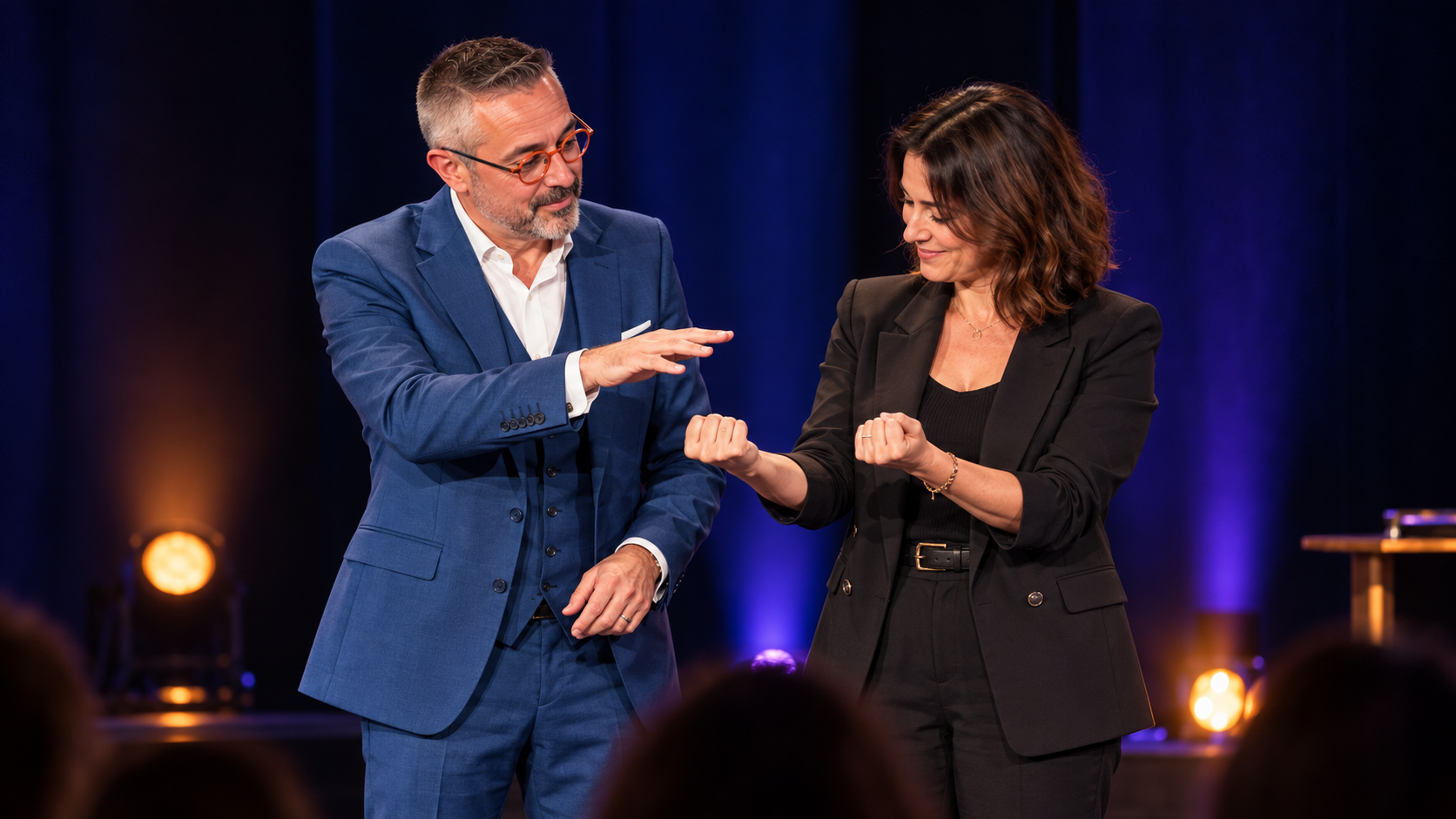
The frame of a keynote has nothing in common with the frame of an interview. That is what changes everything.
What about the machine?
A fair objection: all of this concerns the human eye, and there is a device built for the job. Sensors on the fingertips for skin conductance, a cuff for heart rate, straps for breathing. The polygraph measures precisely what I am about to discuss: a physiological gap between a baseline state and a given moment.
The reference report, commissioned from the US National Academy of Sciences and published in 2003, comes down to three findings. The polygraph does not measure lying; it measures a physiological arousal that is not specific to lying, since fear, anger or the indignation of being accused produce it just as well. On a specific incident, it discriminates clearly better than chance, but well short of perfection. And for large-scale screening, the committee judged it inadequate: the protocols accuse too many innocent people, or let too many guilty ones through.
It is not a lie detector. It is a reaction detector. Remember that, because it governs everything else: a device continuously recording your heart, your breathing and the sweat on your fingers cannot settle the question. A human being counting folded arms across a table has no chance at all.
The delta, and what it actually tells you
So what does someone whose profession is observation actually look at? One thing, and it is not a sign. It is a gap.
Mentalism taught me to spot breaks, and above all not to assign them a cause too quickly. What shows first are the silent answers: the body replies before the mouth does. Tension rising, then something letting go. That release does not tell you someone is lying to you. It tells you that you have just touched something.
This is exactly what Clever Hans did, the Berlin horse who appeared to be able to count. He was not counting: he stopped tapping at the precise moment his questioner relaxed. And his questioners did not even know they were emitting that signal.
A delta is an address, not a verdict.
This nuance is not stylistic caution, it is the heart of the matter. Comparing a person against their own habitual behavior, what is called establishing a baseline, is often presented as the serious method, the professional one. A recent study by Bogaard, van de Bovekamp and Colwell tested that idea on the verbal side: it did not find that deviations from a baseline made it possible to distinguish lies from truths effectively. I cite it even though it weakens my own ground, because it is the honest conclusion: observing a person's variations helps you choose where to ask a question. It does not allow you to conclude that they are lying.
A change may reveal stress, a painful memory, a badly phrased question, a genuine stake, or fatigue. What it does, invariably, is point to a place.
What remains is what to do with that place. This is where one of the most promising experimental avenues comes in, the cognitive approach, notably advanced by Aldert Vrij: lying costs more than telling the truth. You have to invent, memorize your version, monitor its consistency and monitor the other person. That cost cannot be read in a gaze. It surfaces when you increase the load: asking for the account out of order, asking an unexpected question about a central element of the story, the layout of a place, the exact order of a sequence, what happened just before the key moment. Someone telling the truth draws on memory. Someone who has built a version has to recompute.
There is one case where the gap does not occur: the person who has ended up believing their own version. They have nothing left to manage, so they let nothing show.
The meta-analysis devoted to this approach shows a real gain under controlled conditions. It also notes that the accuracy achieved remains insufficient to rule on an individual case.
And even then, the answer proves nothing on its own. It simply indicates where to verify.
You will have noticed that the question has changed. It is no longer "is he lying?", which our spontaneous judgment answers badly. It has become: "what just moved, and where should I dig?" The first question produces fragile verdicts. The second produces conversations, and those are almost always instructive.
What the stage allows, and your office does not
One objection comes up every time, and it is legitimate: if all this is so unreliable, how do you explain what happens on stage?
The answer comes down to one word: the frame.
The studies cited above nearly all measure the same task. An observer watches someone they do not control, in a situation they did not build. That is exactly the position of a recruiter facing a candidate who has prepared for the interview.
On stage, I am not in that position. I choose the question, I choose the moment, I narrow the range of possible answers. When the field of possibilities is narrow and the moment is chosen, what remains to be read becomes far sharper. This is not a gift. It is a protocol, and the credit belongs to the protocol, not to my eye.
Hence two conclusions that must be held together, and that I never separate.
The first: within a frame I control entirely, what I do is reliable. That is what makes the experience striking, and it is also what makes it repeatable night after night.
The second: that frame does not exist in your office. Nobody, in an interview, controls the question, the moment and the range of answers all at once. The figures at the start of this article describe your meeting, not my stage.
What carries over from one to the other is therefore not my reliability. It is the principle: the more constrained the situation, the more legible the gap. An unexpected question about a central point constrains more than an open one. You will never be on stage. You can tighten the frame.
What this changes at work
In recruitment, the lesson is direct: a candidate's nervousness says nothing about their honesty, and their ease says even less. What protects you is not a grid of gestures, it is factual verification of the two lines of the CV that matter, and unexpected questions about the core of the career.
In negotiation, non-verbal behavior returns to its true place: not a detector, a temperature gauge. Your counterpart's variations show you which subjects are sensitive and at what moment your proposal touched something. That is more modest than a verdict on sincerity, and infinitely more useful, because it is achievable.
In management, the Othello error does quiet damage: the employee who is uncomfortable in front of their manager is not disloyal, they are uncomfortable. Mistaking one for the other destroys the very trust that would have allowed you to learn what you were after, simply by asking.
The common thread: replace the fantasy of the detector with a discipline of attention. Spot the gap, choose the place, ask a better question, verify. It is less spectacular than a list of five signs. It is above all something else: a way of listening better, rather than a way of judging faster.
You do not detect a lie. You spot a gap, and then you verify.
A behavior is not proof. An inconsistency is not a verdict. But either one can point to the place where a better question should be asked.
YOUR LEVER
Next time you feel that something is being kept from you, do not look for the sign that proves it. You will not find it, and you will find something worse: a certainty.
Find the place where something moved, ask a question nobody prepares for, and verify what can be verified. You will not get a verdict. You will get a conversation, and that is already far more than five signs will ever give you.
This is exactly what I create in the room, whatever the room: the experience first, the explanation second. Discover my work on reading signals and the hidden drivers of influence in my keynote The Invisible Force of Influence.
And what if your next seminar or company event became the one people are still talking about months later? Discover how mentalism transforms the way your teams experience an event, through my Keynotes & Masterclasses, Team Building and Mentalism Shows, stage and close-up.
Bond, C. F., & DePaulo, B. M. (2006). Accuracy of deception judgments. Personality and Social Psychology Review, 10(3), 214-234.
DePaulo, B. M., Lindsay, J. J., Malone, B. E., Muhlenbruck, L., Charlton, K., & Cooper, H. (2003). Cues to deception. Psychological Bulletin, 129(1), 74-118.
Aamodt, M. G., & Custer, H. (2006). Who can best catch a liar? A meta-analysis of individual differences in detecting deception. The Forensic Examiner, 15(1), 6-11.
The Global Deception Research Team (2006). A world of lies. Journal of Cross-Cultural Psychology, 37(1), 60-74.
Porter, S., & ten Brinke, L. (2008). Reading between the lies: Identifying concealed and falsified emotions in universal facial expressions. Psychological Science, 19(5), 508-514.
Ekman, P. (2009). Telling Lies: Clues to Deceit in the Marketplace, Politics, and Marriage (4th ed.). W. W. Norton.
Vrij, A. (2008). Detecting Lies and Deceit: Pitfalls and Opportunities (2nd ed.). Wiley.
Vrij, A., Fisher, R. P., & Blank, H. (2017). A cognitive approach to lie detection: A meta-analysis. Legal and Criminological Psychology, 22(1), 1-21.
National Research Council (2003). The Polygraph and Lie Detection. Committee to Review the Scientific Evidence on the Polygraph. Washington, DC: The National Academies Press.
Bogaard, G., van de Bovekamp, A. M., & Colwell, K. (2024). Assessing the efficacy of baselining in deception detection: A comparative analysis of the reality interview and structured interview. Acta Psychologica, 242, 104112.